


Sotheby's International Realty
- 74 boulevard de la Croisette
- 06400 CANNES, France
- +33 4 92 92 12 88
Sotheby's International Realty
- 37 boulevard Marinoni
- 06310 BEAULIEU SUR MER, France
- +33 4 92 92 12 88
Sotheby's International Realty
- 3 avenue Denis Semeria
- 06230 SAINT JEAN CAP FERRAT, France
- +33 4 92 92 12 88
Sotheby's International Realty
- 9 avenue Paul Roussel
- 83990 SAINT TROPEZ, France
- +33 4 92 92 12 88
Sotheby's International Realty
- 5 rue Longchamp
- 06000 NICE, France
- +33 4 92 92 12 88
Sotheby's International Realty
- 300 avenue de Tournamy
- 06250 MOUGINS, France
- +33 4 92 92 12 88
- Home
- >
- Tax Laws & Regulations
- >
- DPE reform 2026: impact on property values and electric heating in France
DPE reform 2026: impact on property values and electric heating in France
DIAGNOSIS
From January 1st, 2026, France’s energy performance certificate (DPE – Diagnostic de Performance Énergétique) is evolving. While this reform is primarily technical, its implications are already reshaping the real estate market, influencing property values, buyer behavior, and sales dynamics.
For owners, investors, and international buyers, understanding these changes is now essential.
A revised calculation that favors electric heating
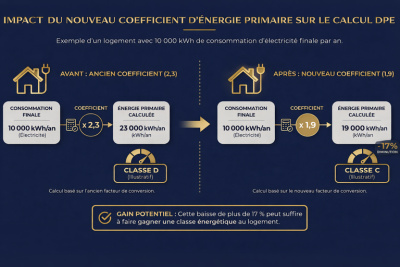
The key change lies in the electricity conversion coefficient, which decreases from 2.3 to 1.9. This adjustment better reflects France’s low-carbon electricity mix, largely based on nuclear and renewable energy.
Until now, electrically heated properties were often penalized in DPE ratings. With the reform, many of these homes will automatically benefit from improved energy classifications, without any renovation work.
Millions of properties upgraded
The impact is significant. Around 850,000 homes are expected to exit the “energy inefficient” categories (rated F or G), while several million properties will gain at least one energy class.
This is particularly relevant for apartments and urban properties, where electric heating is widely used.
However, it is important to note that this is purely a calculation adjustment. Actual energy consumption and utility bills remain unchanged.
DPE: a mandatory document in any real estate transaction
In France, the DPE is a legally required document and forms part of the technical diagnostic file (DDT). It must be provided:
- from the moment a property is listed for sale or rent
- in all real estate advertisements, with clear energy rating display
- at the preliminary agreement (compromis de vente) and final deed
DPE reports are valid for 10 years (for those issued since July 2021) and are legally binding. This means buyers can rely on them, and sellers are accountable for their accuracy.
As a result, the DPE plays a central role not only in informing buyers, but also in price negotiations.
Early market insights: a shift in buyer perception
A recent survey conducted among 2,001 French residents highlights a clear shift in perception following the reform.
Today, 54% of buyers say they are more likely to purchase a property with electric heating, while only 4% report increased reluctance.
More importantly, electric heating is no longer seen as a major drawback. 67% of respondents consider it not to be a barrier to purchase.
A direct impact on pricing and perceived value
Energy performance is becoming a stronger value driver.
52% of buyers are willing to pay more for a property that improves by one or two energy classes. Among them, some accept price increases exceeding 3%.
However, caution remains. Nearly half of buyers are not willing to pay a premium without tangible proof of actual performance and controlled energy costs.
Negotiation margins and time on market
Improved DPE ratings may also reduce negotiation margins. Over half of buyers expect less room for negotiation on upgraded electric properties.
In parallel, 63% believe these homes will sell faster, suggesting a positive impact on transaction speed.
Sellers are also optimistic, anticipating either higher selling prices or shorter marketing periods.
Electricity gaining ground over other energy sources
At equal price and location, electric heating is becoming more attractive than gas for a growing share of buyers.
A D-rated property with electric heating is now perceived as more appealing than a comparable gas-heated home, reflecting a broader shift in energy preferences.
Real performance becomes the key decision factor
Beyond the DPE label, buyers now expect concrete evidence of performance.
The most decisive criteria include:
- insulation quality
- modern heating systems
- smart energy management solutions
- actual energy bills
- a recent and reliable DPE
This marks a fundamental shift. The DPE remains essential, but it is no longer sufficient on its own.
A specific opportunity for second homes on the French Riviera
In markets such as the French Riviera, where second homes represent a significant share of transactions, the DPE reform carries particular importance.
Many apartments, especially in prime coastal locations, rely on electric heating and may benefit from improved energy ratings under the new calculation.
For international buyers and investors, often focused on regulatory clarity and rental potential, this reform enhances the attractiveness of such properties. It may also reduce exposure to future rental restrictions linked to low energy ratings.
In this context, the DPE becomes a strategic tool for assessing long-term value, beyond occasional use, particularly in high-demand lifestyle destinations.
A technical reform with strategic implications
While the 2026 DPE reform is primarily a technical adjustment, its impact is far-reaching. It reshapes property perception, influences pricing strategies, and affects transaction timelines.
For both sellers and buyers, integrating this new energy framework into real estate decision-making is now essential.
Need expert guidance?
The DPE 2026 reform creates new opportunities, but also requires a precise understanding of its real impact on your property or investment.
The teams at Côte d’Azur Sotheby’s International Realty are here to guide you at every stage, from valuation to marketing strategy, integrating energy performance and evolving market dynamics.

Buyers, sellers, and real estate agents, do you really know the rules regarding the SRU withdrawal period? The French Court of Cassation has recently provided an essential clarification on this matter. What is the SRU Period? — A non-professional buyer of a...
Read more
January 22nd 2025 The government, led by François Bayrou, places housing at the heart of its priorities in the 2025 finance bill. Despite an initially vague discourse, the proposals outlined in a letter to socialist leaders sketch a "reimagined and ambitious"...
Read more
The year 2025 marks a significant turning point for the real estate sector in France, with the implementation of numerous regulations stemming from the Climate and Resilience Law. This modernization of the real estate market aims to address environmental and...
Read more