


Sotheby's International Realty
- 74 boulevard de la Croisette
- 06400 CANNES, France
- +33 4 92 92 12 88
Sotheby's International Realty
- 37 boulevard Marinoni
- 06310 BEAULIEU SUR MER, France
- +33 4 92 92 12 88
Sotheby's International Realty
- 3 avenue Denis Semeria
- 06230 SAINT JEAN CAP FERRAT, France
- +33 4 92 92 12 88
Sotheby's International Realty
- 9 avenue Paul Roussel
- 83990 SAINT TROPEZ, France
- +33 4 92 92 12 88
Sotheby's International Realty
- 5 rue Longchamp
- 06000 NICE, France
- +33 4 92 92 12 88
Sotheby's International Realty
- 300 avenue de Tournamy
- 06250 MOUGINS, France
- +33 4 92 92 12 88
- Home
- >
- Luxury real estate
- >
- Seillans: Former Home of Max Ernst and Dorothea Tanning, Two Leading Figures of Surrealism, Offered for Sale
Seillans: Former Home of Max Ernst and Dorothea Tanning, Two Leading Figures of Surrealism, Offered for Sale
November 2026
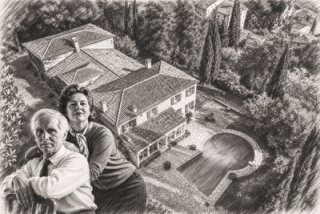
In the Var hinterland of Provence, Côte d’Azur Sotheby’s International Realty presents a property intimately connected to the history of 20th-century art. The last shared residence and studios in the South of France of Max Ernst, the Franco-German artist and pioneer of Dadaism and Surrealism, and his wife Dorothea Tanning, the American painter, sculptor and writer, this remarkable home was conceived in 1967 as a place where life and artistic creation would become inseparable. Acquired in 1989 by a family with a personal connection to Max Ernst, the property has retained its original interiors and fittings since its construction, offering a rare insight into the artists’ creative world and their enduring attachment to Provence.
Max Ernst and Dorothea Tanning: Two Major Figures of 20th-Century Art
Born in Germany, Max Ernst (1891–1976) was among the most influential artists of the European avant-garde. A painter, sculptor and poet, he played a significant role in the emergence of the Dada movement before joining André Breton’s Surrealist circle in Paris. Alongside Salvador Dalí, Joan Miró and René Magritte, he helped redefine modern art, exploring dreams, the unconscious and the transformations of the imagination.
The inventor of frottage and a pioneer of grattage, Ernst produced an extraordinary body of work, including The Elephant Celebes (1921), Two Children Are Threatened by a Nightingale (1924) and Europe After the Rain II (1940–1942). In 1954, he was awarded the Grand Prize for Painting at the Venice Biennale, confirming his international reputation.
Dorothea Tanning (1910–2012), an American artist, also established herself as a major figure in Surrealism. A painter, sculptor and writer, she developed a distinctive artistic universe in which dreams, female figures and familiar interiors acquired an enigmatic dimension. Among her most celebrated works are Birthday (1942), Eine kleine Nachtmusik (1943) and the installation Hôtel du Pavot, Chambre 202 (1970–1973), held in the collection of the Centre Pompidou.
The two artists met in New York in 1942 and married in 1946. Their shared life, spanning the United States and France, brought together two extraordinary creative personalities, united by artistic freedom and a profound personal connection that would eventually find a particularly intimate expression in their home in Seillans.
Seillans: The Provençal Village Chosen by the Artists
In 1964, after spending several years in Paris and the Touraine region, the couple decided to settle in Seillans, a hilltop village in the Pays de Fayence, in the Var hinterland.
They discovered the area through their friends Patrick Waldberg, a writer and art critic closely associated with the Surrealist movement, and Line Jubelin. Captivated by the village’s atmosphere, landscapes and tranquillity, they found an environment ideally suited to both their personal lives and artistic pursuits.
Their first residence, an old house named La Dolce Vita, provided a peaceful retreat before they embarked, several years later, on the construction of the home they would design in the hills above the village.
In a 1990 interview with Barbara Shikler for the Smithsonian Institution’s Archives of American Art, Dorothea Tanning recalled their years in Provence with great affection. She described, among other memories, how Max Ernst had developed the habit of joining local residents for games of pétanque in the village square.
Far removed from the great artistic capitals where his reputation had been established, Ernst found a simpler rhythm of life in Seillans, dividing his time between artistic work, personal encounters and village life. His closeness to the local community stood in striking contrast to the international recognition he had already achieved.
His connection to Seillans remains visible today. On Place de la République, a bronze sculpture by the artist, Le Génie de la Bastille, commemorates his presence and enduring association with the village.
A Home Conceived by the Artists, Designed Around Light and Creativity
From their first residence, Max Ernst and Dorothea Tanning would often gaze towards a hillside overlooking the village. Tanning particularly remembered a shepherd who brought his sheep there to graze.
It was within this Provençal landscape that the two artists began creating their new home in 1967, developing its plans together. Dorothea Tanning played an especially decisive role in the architectural design.
The winter of 1967 marked the beginning of an unusual architectural adventure. Accustomed to translating the images of her imagination onto canvas, Tanning temporarily set aside her brushes to devote herself to designing their future home.
In a text reproduced in the publication Chez Max et Dorothea, she described this alternative form of drawing: no longer composing an image on canvas, but carefully considering the placement of doors, floors and staircases.
At the heart of the project were two spacious, ground-floor artists’ studios, featuring large north-facing windows designed to provide the consistent natural light essential to artistic work. From his studio, Max Ernst was intended to enjoy views across the various spaces of their future estate.
The residence was also conceived as a place for living and entertaining. Arcaded galleries, stone columns, a library, a spacious entrance hall and a grand reception room on the upper floor formed an architectural ensemble in which creative spaces existed alongside areas dedicated to friendship and hospitality.
This ambition continued the architectural experiments the couple had undertaken in Sedona, Arizona, during the 1940s, when Ernst and Tanning had already sought to bring their everyday surroundings into closer dialogue with their artistic practice.
In Seillans, their vision took on a new dimension. The architecture combined Provençal traditions with Italian influences, particularly Venetian references, alongside elements drawn from the artists’ own imagination.
The publication Chez Max et Dorothea notably draws parallels between the house’s arcaded galleries and Italian Renaissance architecture, which the couple had admired during their visits to Venice.
For three years, Dorothea Tanning remained personally involved in every stage of the project: preparing the plans, corresponding with contractors, selecting materials, arranging Moorish-inspired decorative tiles and overseeing construction. In her autobiographical chronology, she even recalled bringing bottles of wine to the workers.
Completed in 1970, the residence stood out for its proportions, marble floors, arcaded galleries and two magnificent studios.
For Dorothea Tanning, the house represented far more than a residence. She regarded it as a personal creation, comparable to a painting she had never signed.
The property thus became an extension of their artistic universe, a place where architecture, landscape and creativity formed part of a single vision.
A Distinctive Architectural Vision, Down to the Finest Details
The personalities of Max Ernst and Dorothea Tanning are reflected in even the most unexpected details of the property. Little appears to have been left to chance: the forms, materials and arrangement of the spaces each reveal something of their creators’ artistic world.
Outside, the swimming pool is perhaps one of the most original expressions of this creative freedom. Designed by Max Ernst himself, its unusual silhouette evokes both a keyhole and a champagne cork. In Chez Max et Dorothea, these two symbols are associated with mystery and celebration. The keyhole, a recurring motif in Ernst’s imagination, suggests an opening into hidden worlds, while the champagne cork evokes festivity and the joy of living.
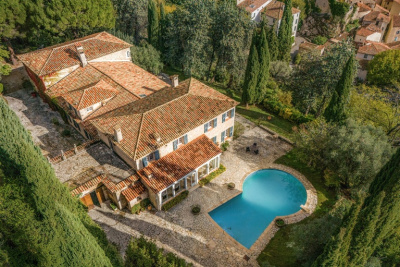
The house holds other surprises. Its elegant arcaded galleries and colonnade reveal the influence of Italian, particularly Venetian, architecture. According to Chez Max et Dorothea, the colonnade is believed to have been a gift from Georges Pompidou, then President of France, a passionate admirer of modern art and a collector of Max Ernst’s work.
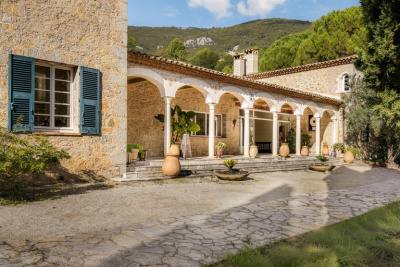
The book also recounts a remarkable anecdote: Madame Pompidou is said to have arrived by helicopter to visit the property, illustrating the connections the artists maintained with prominent figures from the cultural and political worlds of their time.
Another intriguing detail concerns certain decorative tiles within the residence which, according to an account reproduced in the same publication, may have been designed by Salvador Dalí, another leading figure of Surrealism. This attribution remains to be documented, adding a further element of mystery to the house’s architectural history.
Inside, Dorothea Tanning designed a magnificent reception room on the upper floor, which she affectionately called her ballroom. Conceived as a space for welcoming friends and guests, it reflected her desire to make the residence a place of gathering and shared experiences, extending beyond the studios devoted to artistic creation.
From the moment of its completion, the house impressed visitors with its architecture and originality. Tanning later recalled that some people already imagined the property becoming a museum after the artists’ deaths, so distinctive was its design and so enduring its character.
That observation carries particular significance today: nearly sixty years after construction began, the property retains its original fittings, from the kitchen to the bathrooms. It offers an exceptionally rare glimpse into the private world of Max Ernst and Dorothea Tanning, carefully preserved over the decades.
A Place of Artistic Creation and Personal Memories
In Seillans, both artists continued their creative explorations in an environment conducive to experimentation.
Max Ernst pursued the techniques and artistic processes that had defined his career, particularly printmaking and lithography. Several prints produced during this period were created in collaboration with the Chave lithography workshop in Vence.
Meanwhile, Dorothea Tanning continued developing her painting and soft sculptures. The residence’s two studios reflected the couple’s determination to place artistic creation at the very centre of their daily lives.
The house became their last shared residence and place of work in the South of France, bringing together the intimacy of their private lives and the continuation of two remarkable artistic careers.
At the entrance, an inscription carved into a wooden beam lends the property a particularly moving significance:
Patet Porta Sed Magis Cor
“The door is open, but the heart even more so.”
This motto seems to capture the spirit of the residence: at once a personal sanctuary, a place of artistic work and a home devoted to friendship and hospitality.
Following Max Ernst’s death on 1 April 1976, Dorothea Tanning faced the difficult prospect of parting with the home whose construction she had so carefully supervised. In her 1990 interview, she spoke emotionally about this separation, which she associated with another experience of loss.
Yet her attachment to Seillans endured long after her departure.
In 1994, Dorothea Tanning donated a collection of prints by Max Ernst and herself to the municipality, helping preserve the couple’s artistic legacy within the Provençal village.
These works are now housed at the Maison Waldberg, the former holiday residence of art critic Patrick Waldberg, which has become a cultural venue dedicated in part to the two artists.
The donation bears witness to the lasting connection between Seillans and the history of Surrealism. It also reflects the special place the village continued to hold in Dorothea Tanning’s life long after Max Ernst’s passing.
A Family History Closely Connected to Max Ernst
The story of this remarkable residence continued long after Dorothea Tanning’s departure, through a family whose relationship with Max Ernst dated back to the artist’s years in Seillans.
In 1989, the property was acquired by a former employee of Max Ernst and his wife. Their personal connection to the artist played a decisive role in the decision to purchase the house, to which they would remain deeply attached.
Over the following decades, the family took great care to preserve the residence in its original condition, without altering its architectural identity or interior arrangements.
Remarkably, the kitchen, bathrooms and original fixtures have been retained as they were conceived when the house was built by Max Ernst and Dorothea Tanning.
According to information provided by the family, all the original fittings remain in place, offering an exceptionally valuable insight into the artists’ aesthetic choices and everyday lives.
This continuity gives the property a distinctive heritage significance. While many historic residences have undergone extensive alterations over time, this home has passed through the decades while preserving the essence of its original character.
Today, following the passing of their parents, the four heirs have decided to offer the property for sale.
This decision brings to a close nearly four decades of family history and opens a new chapter for a residence whose remarkable authenticity has become one of its defining qualities.
A 625 sq m Estate Overlooking the Medieval Village
Today, this former artists’ residence retains an identity deeply rooted in its history and natural surroundings.
Offering approximately 625 sq m of living space within 1.2 hectares of grounds, the property occupies an elevated position with remarkable views across the rooftops of medieval Seillans and the landscapes of the Var hinterland.
Its arcaded galleries, reception rooms, artists’ studios and uniquely shaped swimming pool form an architectural ensemble unlike any traditional Provençal residence.
Beyond its dimensions, the estate is distinguished by the personalities of its former occupants and the story behind its creation. Its significance lies in the extraordinary meeting of architectural heritage, artistic memory and the Provençal art of living.
An Artistic Legacy for Future Generations
The sale of this former residence of Max Ernst and Dorothea Tanning, presented by Côte d’Azur Sotheby’s International Realty, brings renewed attention to a place intimately associated with two extraordinary artistic careers.
In the world of luxury real estate, certain properties possess a value that extends far beyond their architecture or location. Their history, provenance and the remarkable individuals who once lived within their walls become an essential part of their identity.
In Seillans, this dimension is particularly meaningful. The house bears witness to a period of artistic creation, a profound creative partnership and the attachment of two artists to a Provençal landscape. It also tells the story of a family who, for nearly four decades, devoted themselves to preserving this exceptional heritage.
Fifty years after the death of Max Ernst, this remarkable property remains a testament to a life in which art and everyday existence were inseparable.
About Côte d’Azur Sotheby’s International Realty
Côte d’Azur Sotheby’s International Realty Mougins assists French and international clients with the acquisition and sale of prestigious properties throughout the French Riviera and its hinterland. As an affiliate of the Sotheby’s International Realty network, the agency combines local real estate expertise, personalised service and international reach, with particular attention to historic estates, architecturally significant residences and exceptional character properties.
Côte d’Azur Sotheby’s International Realty, 300 avenue Tournamy, 06250 Mougins, France
Photographic materials and further information available upon request.
November 2026 In the Var hinterland of Provence, Côte d’Azur Sotheby’s International Realty presents a property intimately connected to the history of 20th-century art. The last shared residence and studios in the South of France of Max Ernst, the Franco-German artist…
Read more
Set within the historic grounds of Château de l’Anglais in Cap de Nice, a 1930s villa celebrates a distinctive architectural identity. With its eclectic detailing, delicate colour palette and views of the Mediterranean, Villa Bambino offers a glimpse into Nice’s rich…
Read more
In Beaulieu-sur-Mer, between Nice and Monaco, a remarkable residence stands out for its generous entertaining spaces and the history associated with its address. Once known as Castel Fleuri, the property recalls a significant moment in French history: General Charles…
Read more