


Sotheby's International Realty
- 74 boulevard de la Croisette
- 06400 CANNES, France
- +33 4 92 92 12 88
Sotheby's International Realty
- 37 boulevard Marinoni
- 06310 BEAULIEU SUR MER, France
- +33 4 92 92 12 88
Sotheby's International Realty
- 3 avenue Denis Semeria
- 06230 SAINT JEAN CAP FERRAT, France
- +33 4 92 92 12 88
Sotheby's International Realty
- 9 avenue Paul Roussel
- 83990 SAINT TROPEZ, France
- +33 4 92 92 12 88
Sotheby's International Realty
- 5 rue Longchamp
- 06000 NICE, France
- +33 4 92 92 12 88
Sotheby's International Realty
- 300 avenue de Tournamy
- 06250 MOUGINS, France
- +33 4 92 92 12 88
- Home
- >
- Luxury real estate
- >
- The Latitude 43: jewel of modernist architecture in Saint Tropez
The Latitude 43: jewel of modernist architecture in Saint Tropez
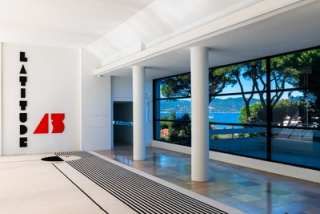
An iconic address on the French Riviera, the Palais Latitude 43 stands out with its modernist architecture designed by Georges-Henri Pingusson. Built in 1932 as a prestigious hotel, it originally featured over a hundred rooms, a casino, a restaurant, a shopping arcade, a swimming pool, as well as tennis courts and sports grounds.
Now listed in the French Inventory of Historic Monuments, this landmark building fascinates with its history, its ocean-liner spirit, and its prime location, just a few minutes’ walk from the center of Saint-Tropez and its beaches. Nestled in a lush Mediterranean park, it perfectly combines heritage, elegance, and the unique Tropezian art of living.
A tumultuous history
Pingusson's testimony provides a clear picture of the conditions of the order. It resulted from a meeting in the port of Sainte-Maxime between boating enthusiasts and Georges Bernet - a former manager of Parisian hotels, and his wealthy companion Renée Gaudin. Georges Bernet had bought a piece of land away from the historic center of Saint-Tropez, with the intention of building a hotel. An ambitious project resulted from their discussions, even though Saint-Tropez was still only a modest fishing port.
Early celebrated by painters such as Signac, the village was not, however, popular with the Parisian and international clientele that a prestigious hotel program required. A number of insecure choices and unfavorable socio-economic circumstances would make the fate of Latitude 43 chaotic, to say the least.
The construction and hotel period
The first plans were delivered on October 19, 1931, and the construction work, which was very rapid, was spread over the first six months of 1932.
On July 14, 1932, the reinforced concrete hotel was delivered with its annexes accessible to an outside public (swimming pool, casino, dance hall). But quickly considered unprofitable, it was bought by a Russian billionaire, Georges Khiagine.
After four summer seasons, the hotel was declared bankrupt. The establishment and its influence gradually disintegrate.
The reuse during the war
During the Second World War, the hotel was requisitioned by the French state and successively occupied by Italian, German, American troops and the French state again. In 1944 the American army established its headquarters there.
The return to civilian life
The reopening after the war is brief and followed by the purchase of the developer Lefebvre-Despeaux in 1948, which in 1950, after heavy transformations, resells the building divided into apartments and the land in lots.
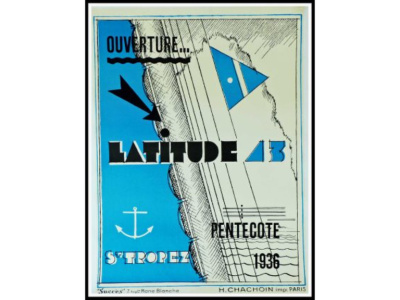
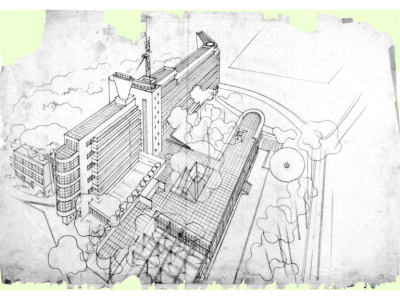
LATITUDE 43 - Pentecost opening 1936 - Saint Tropez | Latitude 43 - Georges-Henri Pingusson - 1931/1932 - At the Centre Pompidou by donation from Olivier Dugas in 2012
Distinctive architecture in the region
The Latitude 43 is a modern palace conceived and built at the beginning of the 1930s, after 10 years of realizations of the same architectural movement, the Mouvement Moderne. As early as the 1920s, members of this movement illustrated their sensibility on the Var coast in the context of commissions for vacation homes: Rob Mallet-Stevens, Pierre Chareau, Djo Bourgeois, Pierre Barbe, Le Corbusier... The commission for a large hotel in Saint-Tropez would lead its architect to become a legend.
Latitude 43 is a reference in contemporary architecture, its long silhouette reminiscent of an ocean liner. The building was listed as a historical monument in 1992.
It is not usually open to the public except on Heritage Days when visitors can access the passageways.
A special commission
The commission given to Pingusson is rare, exceptional because it engages him in the design of a total work of art. He designed everything from the company logo to the furnishings, including the crockery, the stationery, the costumes of the various employees. The whole thing is related to the spirit and the most advanced forms of modernity.
Latitude 43, the name of the building, immediately announces the futuristic sensibility of this modern project, comparable to the contemporary villa E1027 by Eileen Gray and Jean Badovici in Roquebrune-Cap-Martin. Upon completion, the hotel was acclaimed by the press and professional critics.
While the outdoor furniture is made of wood and the restaurant chairs are made of rattan, the furniture in the rooms is based on the principle of tubular structures dear to the Bauhaus (Stam, Breuer) and the "Useful Forms" of the Union of Modern Artists (UAM) created in 1929, of which Pingusson was one of the most ardent protagonists.
The decoration of the rooms is sober and uncluttered, the architect justifies it by the desire for a monastic atmosphere conducive to rest and meditation. The contribution of some artists is solicited.
The reception room is decorated with a fresco by the English painter Harry Bloomfield and the walls of the rooms are decorated with works by the English painter Roger Nickalls, a student of André Lhote. The large carpet in the hall was designed by the architect with the help of his companion Micheline Laurent and will be manufactured by the carpet factory in Cogolin.
References to boating
The reference to nautical, the "liner style", which is one of the markers of the modernity of the interwar period - the great era of transatlantic ships - marks the character of Latitude 43. The flag at the entrance, the large chimney at the top of the building, the presence of portholes on the stairwell, on the west side and on the upper part of the building, are all details that contribute to this.
The "improvement" work undertaken from 1937, again with Pingusson's contribution, did not alter the original spirit but on the contrary improved the access sequence (large canopy), completed the composition of the gardens (sculpture/water net/pond), invested the beach space (pier), substituted the characteristic modern white plaster for the original yellow-brown one.
Living there
The address is sought-after : a few minutes walk from the center of Saint-Tropez and close to the sandy beach of La Bouillabaisse. Côte d'Azur Sotheby's International Realty offers to enter the legend of this mythical Tropezian building through 4 luxury apartments within this exceptional residence :
- A through apartment of approximately 80 m² offering great renovation potential, with contrasting views over the Bay of Saint-Tropez and a peaceful pine grove.
- A rare 125 m² apartment with a vast 125 m² rooftop terrace, a true house-like feel suspended between the sea, the village, and the parasol pines.
- An apartment of about 130 m² with large bay windows and two balconies/loggias, revealing a panoramic view of the port, the village rooftops, and the Mediterranean.
- An elegant 112 m² four-room apartment extended by a panoramic terrace, featuring two master suites with private loggias and refined finishes.
- A bright, perfectly maintained 83 m² two-bedroom apartment, enhanced by four south-facing balconies totaling 19 m², with breathtaking views of the sea and the port of Saint-Tropez.
For more information on this exceptional property or for any real estate project in the basin of Saint-Tropez, contact your experts in prestige real estate at Côte d'Azur Sotheby's International Realty.
Nice, the capital of the French Riviera, is a prime destination for those seeking a long-term investment in real estate. Known for its unique lifestyle, the city offers ideal amenities for families and boasts exceptional infrastructure. Its proximity to major hubs…
Read more
In 2026, acquiring a second home on the Riviera is no longer just about lifestyle preferences - such as a pool, sea view, or a specific number of bedrooms - it is a strategic long-term heritage investment. In a market that has stabilized following the fluctuations of…
Read more
A conversation with Margaux Perrier, Anastasia Panacheva, and Frédéric Michelangeli — In the heart of the Gulf of Saint-Tropez, the hills slip into the sea, the light settles on ochre façades, and contemporary lines reflect across infinity pools. Here, architecture is…
Read more